
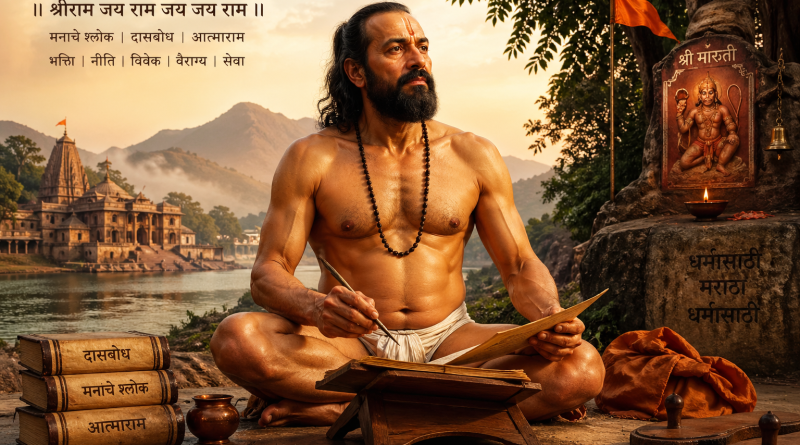
Books Authored By Samarth Ramdas: What Do They Contain?
Introduction
Samarth Ramdas was not merely a spiritual master but also a great thinker and literary visionary. His works, mostly written in Marathi, transcend devotional verse; they present an entire system of spiritual development, morality, and practical wisdom. Ramdas opposed many saints who focused solely on mysticism and developed texts that led to inner change and worldly achievement, thereby making his works everlasting and highly applicable.
Scope of his Literary Vision
The literary works of Ramdas are manifold. His works may be divided into:
- Philosophical treatises
- Devotional compositions
- Ethical and psychological guidance books.
- Practical and social manuals.
Some of his most notable works include Dasbodh, ManacheShlok, Aatmaram, and other hymns such as Karunashtakas. They are a guide to life and spirituality in totality.
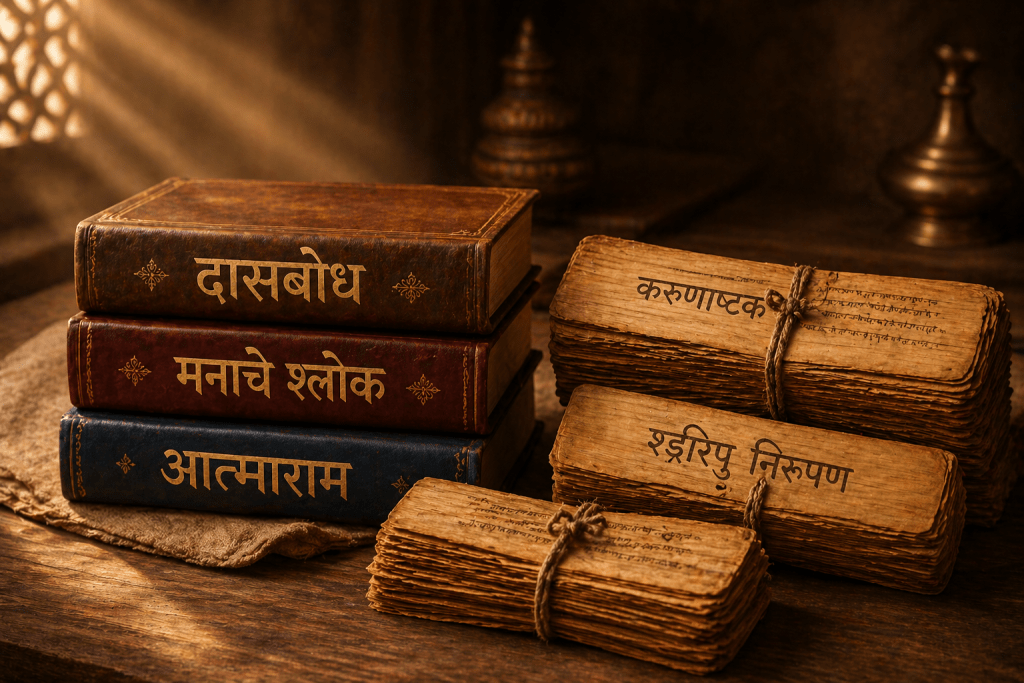
Dasbodh: The Master Blueprint of Life
Structure and Composition
The greatest work of Samarth Ramdas is Dasbodh. It is organized as a conversation between a guru and a disciple in 20 chapters (Dashakas), and each of them includes very specific teachings.
Core Themes
This writing is not confined to spirituality; it is a holistic guide to life. It covers:
- Personal realization and reality.
- Path of devotion and renunciation.
- Decision-making, governance, and leadership.
- Wise application to everyday life.
- Control of the mind and ego.
The peculiarity of Dasbodh is that it is a perfect combination of Vedantic philosophy and its practical implementation to the real world, and it is as helpful to the seekers, leaders, and householders.
ManacheShlok: Mastering the Mind
Nature of the Work
ManacheShlok is a compilation of approximately 200+ short, highly impactful verses that directly appeal to the human mind.
Key Teachings
- Removing ego, anger, and greed
- Discipline and self-control
- Nurturing modesty and piety.
- Constant remembrance of Lord Rama.
The work is a mirror to the mind, with simple but deep teachings to establish stability inside and clarity of morals. Its practical tone endears it to be one of the most recited works of Ramdas.
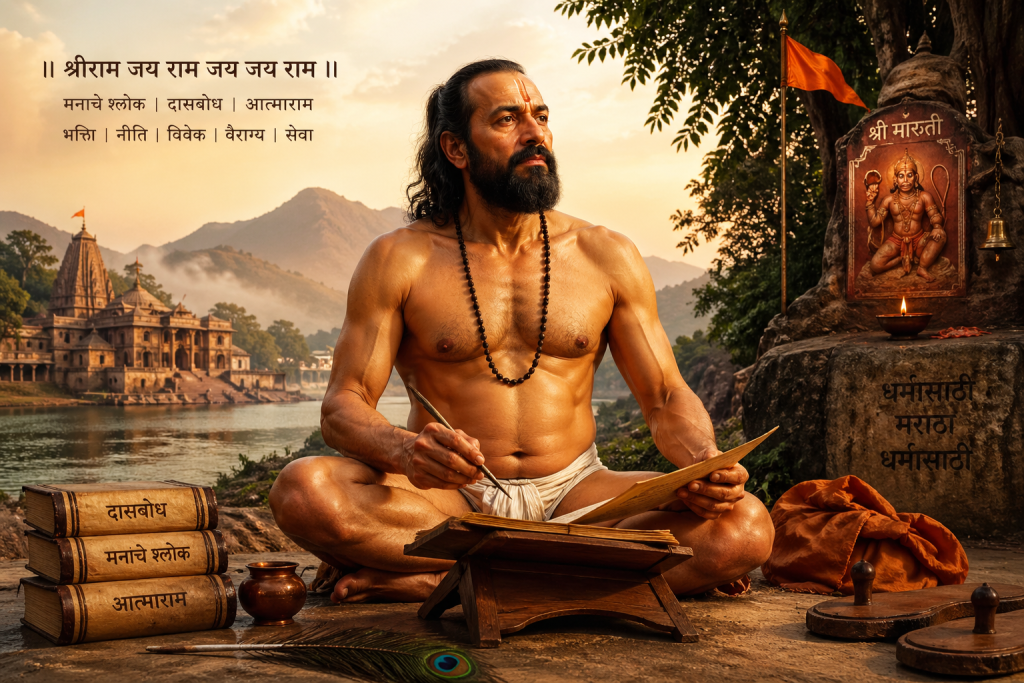
Aatmaram: Journey into the Self
Philosophical Depth
Aatmaram explores more metaphysical inquiries and reflects the work with Advaita Vedanta (non-dualism) of Ramdas.
Central Ideas
- Realizing that the aatmaa (Self) is really not what it appears.
- Separating body, mind, and soul.
- Coming to know oneness with the ultimate reality.
This reading makes it clear that liberation is not acquired through any outward practices, but through self-awareness and inner understanding.
Devotional Literature: Karunashtakas and Stotras.
Devotional songs of Ramdas, such as Karunashtaka and other stotras, are characterised by a feeling of love and submission to the divine.
Features
- Poetic beauty and depth of feelings.
- Eulogy of gods such as Rama and Hanuman.
- Focus on compassion, surrender, and grace.
The works cultivate bhakti (devotion) and are still read in spiritual practices in India.
Ethical and Psychological Reflections: Shadripu Nirupan
Ramdas discusses the six inner enemies (Shadripu): in such texts as ShadripuNirupan:
- Lust (Kama)
- Anger (Krodha)
- Greed (Lobha)
- Attachment (Moha)
- Pride (Mada)
- Jealousy (Matsarya)
He presents the practical ways of overcoming these tendencies, and his teachings have great application to personal development and mastery.
Social Ideology and Practical Direction
The writings of Ramdas are not disconnected from society. He addressed:
- Social issues and moral decay of his era.
- Strength, unity, and courage are important.
- The necessity to be actively involved in society.
His writings promote a balance between the spiritual (seeking) and social (responding), and this makes them both thought-provoking and doctrinal.
Conclusion
Samarth Ramdas has a literary legacy of a rare mixture of spiritual depth, moral insight, and practical common sense. His works are three-dimensional:
- Spiritual: Dasbodh, Aatmaram – to self-realization.
- Psychological, Ethical: ShadripuNirupan, ManacheShlok – character-making.
- Devotional: karunashtakas and stotras – fortifying Godly relationship.
They form an integrated map to reach liberation and live a meaningful life of power, wisdom, and discipline.
You may also like to read:
- Swami Samarth Ramdas – A Brief Introduction
- The Living Legacy Of The Samarth Sampradaya: Tradition In Practice Today
- Samarth Ramdas, His Guru And Ramdasi Parampara
- Spiritual Blueprint Of Swarajya: The Influence Of Dasbodh In The Rule Of Shivaji