
Adi Shankara – 4 Great Mutts, Founding Peetadhipathis, Ten Orders (Dandis + Gosains)
Introduction
Adi Shankaracharya, the great philosopher and religious leader, not only revived Advaita Vedanta but also firmly established it as the highest school of philosophy (Vedantam) among the various darshanas. The position of Vedanta as the most supreme darshana was firmly established by him. The greatest exponent of the previous competing darshana i.e. Mimamsa whose name was Mandana Mishra accepted Adi Shankaracharya’s proposition of Vedanta being supreme. Mandana mishra became a disciple of Adi Shankaracharya taking his new name as Sureshwaracharya.
Adi Shankaracharya organized the Smarta tradition. While Shaiva traditions exclusively focus on Bhagwan Shiva, the Smarta tradition does Panchayatana worship of 5 deities – Shiva, Vishnu, Surya, Devi and Ganesha. Adi Shankaracharya Bhagavatpada established the Dasanami system with the ten monastic orders and the four great Maths across India. These centers, led by his disciples, ensured spiritual discipline, learning, and the spread of Vedantic wisdom
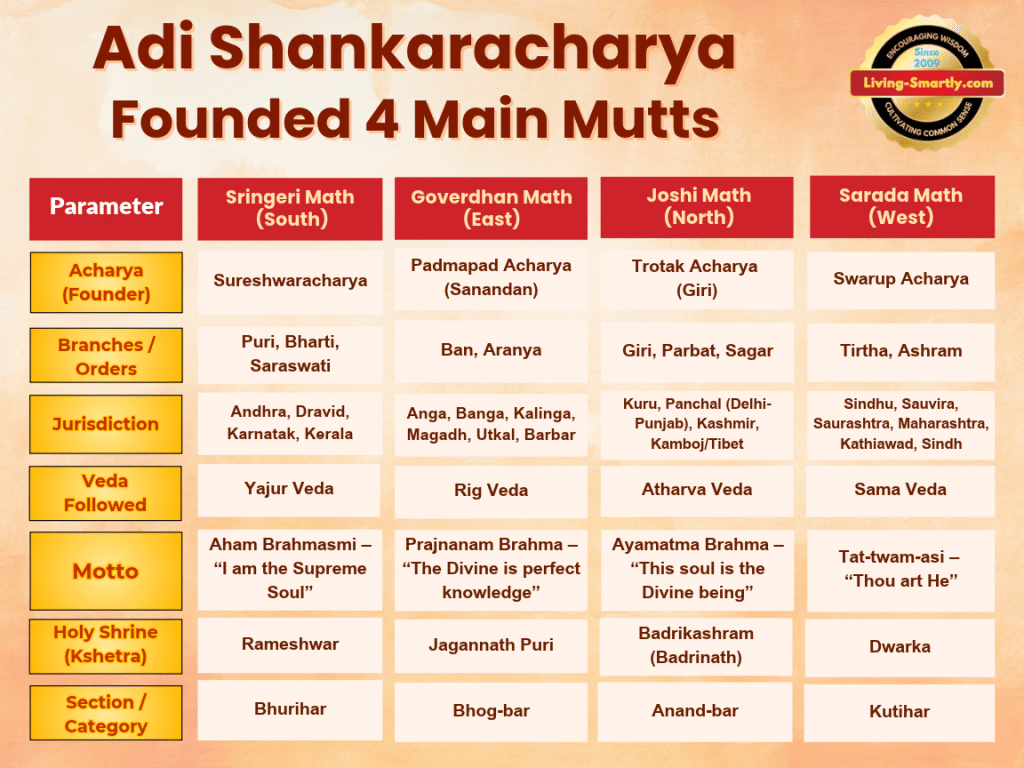
The Four Great Maths & Founding Acharyas
Tradition speaks of four great monasteries at the four strategic points of India, each placed under a direct disciple of Shankaracharya. These four Maths became the central authorities of the Dasanami orders.
- South – The Sringeri Math, under Sureshwaracharya. To this, the Puri, Bharti, and Saraswati branches are attached. Jurisdiction – Andhra, Dravid, Karnatak and Keral countries. Yajur-veda is followed. Novices affix the title of Chaitanya to their names. Motto: Aham Brahmasmi – “I am the Supreme Soul”. Its Holy Shrine (Kshetra) is Rameshwaram. Bhurihar section.
- East – The Goverdhan Math at Jagannath Puri, placed in charge of Padmapad Acharya (originally called Sanandan). The Ban and Aranya orders are attached to this centre. Jurisdiction: Anga, Banga, Kalinga, Magadh, Utkal and Barbar. Rig Veda followed. New Sadhus in this mutt affix the title Prakash to their names. Motto: Prajnanam Brahma – “The Divine is perfect knowledge”. Holy shrine (Kshetra) Jagannath-Puri. Bhog-bar section.
- North – The Joshi Math at Badri-Kedarnath in the Himalayas, under Trotak-acharya, originally named (Giri). To this Math, the Giri, Parbat and Sagar orders are attached. Jurisdiction: Kuru, Panchal, i.e., Delhi-Punjab, Kashmir, Kamboj, or Tibet &c. Atharva Veda followed. New Sadhus in this mutt take the title of Ananda. Motto: Ayamatma Brahma – “This soul is the Divine being”. Its holy shrine, Badrikashram(Badrinath). Anand-bar section.
- West – The Sarada Math at Dwarka, placed in charge of Swarup-acharya. The Tirtha and Ashram branches are assigned to this Math. Jurisdiction – Sindhu, Sauvira, Saurashtra, and Maharashtra, i.e., Western India and Kathiawad, including Sindh. Sama Veda followed. New Sadhus in this mutt given the title of Swarup. Motto Tat-twam-asi – “Thou art He”. Holy shrine, Dwarka. Kutihar section.
The Ten Orders (Dasanama)
The ten branches of the Advaita school of smartas which Shankaracharya organized (or revived) are known as the Dasanama or “Ten Names”.
These ten words form the suffixes to the names taken by monks after initiation (diksha):
- Giri (hill)
- Puri (city)
- Bharti (learning)
- Ban (wood)
- Aranya (forest)
- Parbat (mountain)
- Sagar (ocean)
- Tirtha (temple)
- Ashram (hermitage)
- Saraswati (perfect knowledge)
Gosains vs Dandi Sannyasis
Of the ten names:
- The Tirthas, Ashramas and Saraswatis, and half of the Bharatis are called Dandis.
- The remaining six and a half groups are entitled to call themselves Gosains.
The Dandi Sannyasis carry the staff (danda) and represent the stricter discipline.
Within each order, the monks are also graded according to spiritual progress into 4 levels, i.e.
- Kutichak
- Bahudak
- Hansa
- Paramhansa
The first two classes are called Tri-dandis (holding three rods, symbolising control of speech, thought and action), while a Hansa or Paramhansa is called an Ek-dandi or Dandi (carrying one staff only).
Thus, the Dasanami system combines the four great Maths, the ten orders, the founding Acharyas, and the distinction between Gosains and Dandis into an organised monastic structure under central spiritual authority.
Shankaracharya’s Four Maths – Structural Grid
|
Acharya (Founder) |
Sureshwaracharya |
Padmapad Acharya (Sanandan) |
Trotak Acharya (Giri) |
Swarup Acharya |
|
Branches / Orders |
Puri, Bharti, Saraswati |
Ban, Aranya |
Giri, Parbat, Sagar |
Tirtha, Ashram |
|
Jurisdiction |
Andhra, Dravid, Karnatak, Kerala |
Anga, Banga, Kalinga, Magadh, Utkal, Barbar |
Kuru, Panchal (Delhi-Punjab), Kashmir, Kamboj/Tibet |
Sindhu, Sauvira, Saurashtra, Maharashtra, Kathiawad, Sindh |
|
Veda Followed |
Yajur Veda |
Rig Veda |
Atharva Veda |
Sama Veda |
|
Motto |
Aham Brahmasmi – “I am the Supreme Soul” |
Prajnanam Brahma – “The Divine is perfect knowledge” |
Ayamatma Brahma – “This soul is the Divine being” |
Tat-twam-asi – “Thou art He” |
|
Holy Shrine (Kshetra) |
Rameshwar |
Jagannath-Puri |
Badrikashram (Badrinath) |
Dwarka |
|
Section / Category |
Bhurihar |
Bhog-bar |
Anand-bar |
Kutihar |
You may also like to read: