
How Orientalist Degradation Of Bharatiya 64 Kalā Could Serve British Industrial Interests In The 19th Century
The 64 kalas are central to traditional Indian culture.
This traditional concept encompassed a diverse array of human knowledge and skills, and, contrary to public opinion, it was not constrained to handicraft alone. They included innumerable activities such as Music, Dance, Painting, Textiles, Cooking, Carpentry, Architecture, Metalwork, and Jewellery.
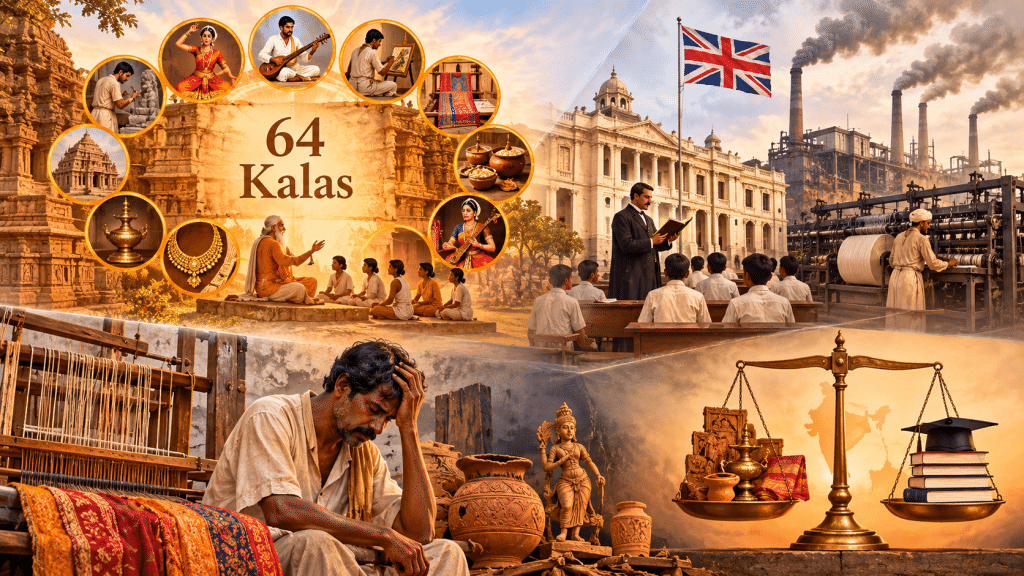
You will find separate lists of these arts in different Sanskrit texts. Together, they represent a wide-ranging understanding of knowledge in which creative expression of the artists, their technical abilities, and practical skills all commanded enormous value.
Colonial Education Changed the Status of Traditional Knowledge
The educational policies in the British era placed a whole lot of focus on certain core aspects-examinations, classroom-based curriculum learning, and certification. Knowledge provided through formal schooling started to get more recognition compared to knowledge that you gained through years of real, practical, hands-on experience.
Traditional artisans often found that their knowledge was not accorded the same standing in terms of value as Western-style technical education – this, despite having top-of-the-line skills.
Colonial industry schools did offer practical training but mostly eulogised European scientific methods over existing Indian techniques.
British Industrial Growth Created Economic Competition
The British saw fast industrial growth during the 19th century. Thanks to mechanised weaving and spinning, British manufacturers were able to produce cotton goods at a much bigger scale.
At that time, Indian textiles were already significantly popular outside its shores. However, cotton cloth and yarn, made by the British, started to gain more popularity in Indian markets from the 1920s.
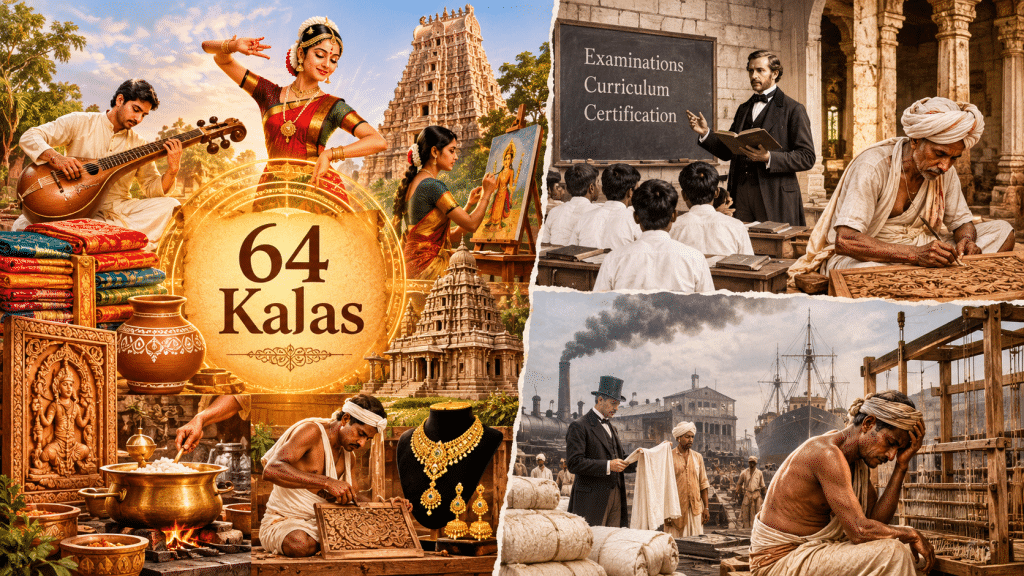
Indian handicrafts workers were now basically at loggerheads with more manufacturing units imbibing recent technologies, large-scale production, and capital. Colonial trade arrangements made things even easier for British manufacturers.
Orientalist Thinking Created a Hierarchy of Knowledge
- According to Orientalist thinking and presentation, India was a culturally rich ancient civilization basically out of tune with contemporary industrial and technical abilities.
- While Indian traditions and arts were to be admired as exotic cultural achievements, the knowledge of living artisans was written off as unscientific and/or old-fashioned.
- This distinction had some serious consequences. Traditional occupations slowly lost social prestige while Western technology and education became the epitome of modernity.
Indian Artisans Paid a Heavy Economic and Social Price
Many traditional Indian industries were critically disrupted because of industrial competition and British economic policies. Moreover, the impact diverged based on areas and occupations. Some handloom communities adapted, and that helped them endure. However, others suffered substantial losses.
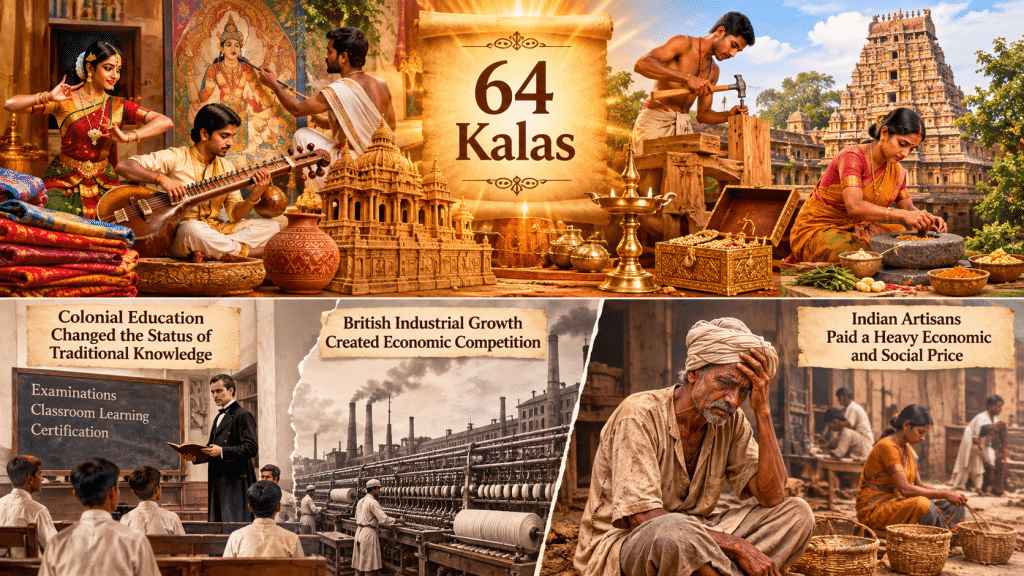
Many craftspeople also faced problems like fewer opportunities to improve their products, which limited their ability to reach wider markets – declining incomes also plagued them. Indian producers were also stuck with lower-value work.
Conclusion
Something that needs to be understood is “the varied impact of colonialism”. It would be quite hard to establish that the British consciously set about destroying the 64 kalas with their policies. However, thanks to the combined workings of factors like colonial education, industrial competition, and economic policies, the position of many traditional Indian craft forms was severely weakened. This is without a doubt!
Also, the significance of this was not just limited to the loss of income!