
Criticizing British Colonial Rule For Introducing Foreign Plants Recklessly In Public Spaces
During the British rule in India, colonial administrators introduced a wide array of foreign plants and trees. To date, most of the trees can be widely spotted in the public spaces across the country. In more recent years, these plant species have faced rising inspection and even disparagement for their enduring economic, ecological, and cultural impacts.
Some of the preferred species were extensively planted across roadsides, parks, and in the administrative areas. These include certain specific species such as Peltophorum pterocarpum (Copperpod), Eucalyptus globulus, and Delonix regia (Gulmohar). Hence, most of these species of trees played an imperative role in ever-changing the Indian landscapes to a great extent. Furthermore, it still continues to influence the urban environments even today.
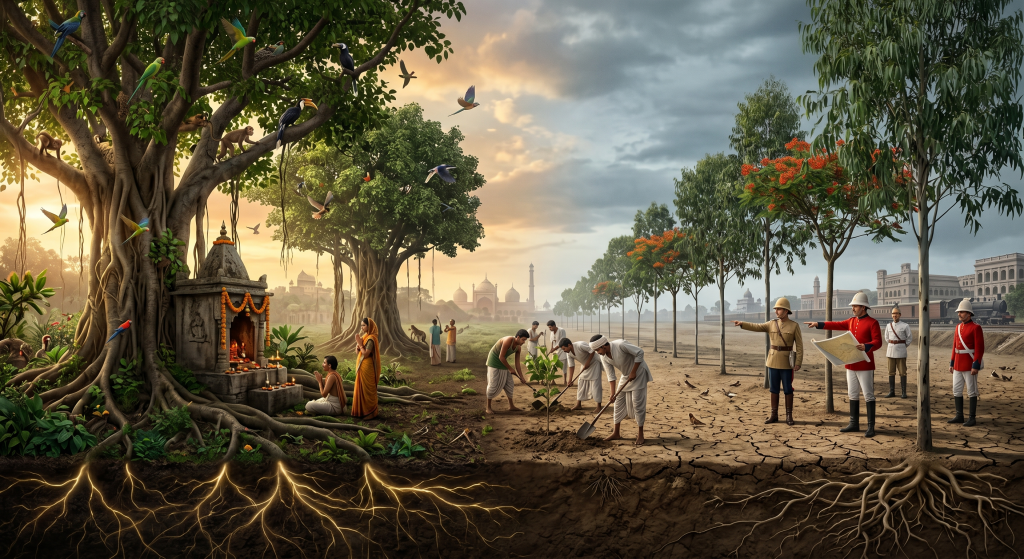
Colonial landscaping practices were purely aesthetic and scarcely neutral. Instead, they echoed imperial priorities. Specifically, their choices were centred on administrative convenience, economic advantage, and European tastes.
A central criticism is that these trees commonly disrupt native ecosystems. For example, Eucalyptus depletes groundwater. It has been widely condemned for its high water consumption. Hence, it undesirably disturbs nearby vegetation and agriculture. Many familiar foreign species were ill-suited to India’s climate and environmental conditions, often permitting them to undermine biodiversity and outcompete indigenous plants. These ecological imbalances can cause lasting, cascading effects, especially in densely populated urban areas with limited green spaces.
Along with this, another delinquent area linked with this ecological disturbance was that the exotic trees often replaced many indigenous species. Most traditional landscapes in India were full of native tree species like Azadirachta indica (Neem), Ficus benghalensis (Banyan), and Ficus religiosa (Peepal). Additionally, these trees effectively supported biodiversity with spiritual and cultural importance.
On the other hand, to make spaces for more ornamental and exotic species that were more in line with European aesthetic preferences, colonial urban planning practices regularly got rid of these trees. Hence, such a shift not only changed the ecological structure and fabric of the cities but also abolished the presence of spiritually and culturally meaningful landscapes.
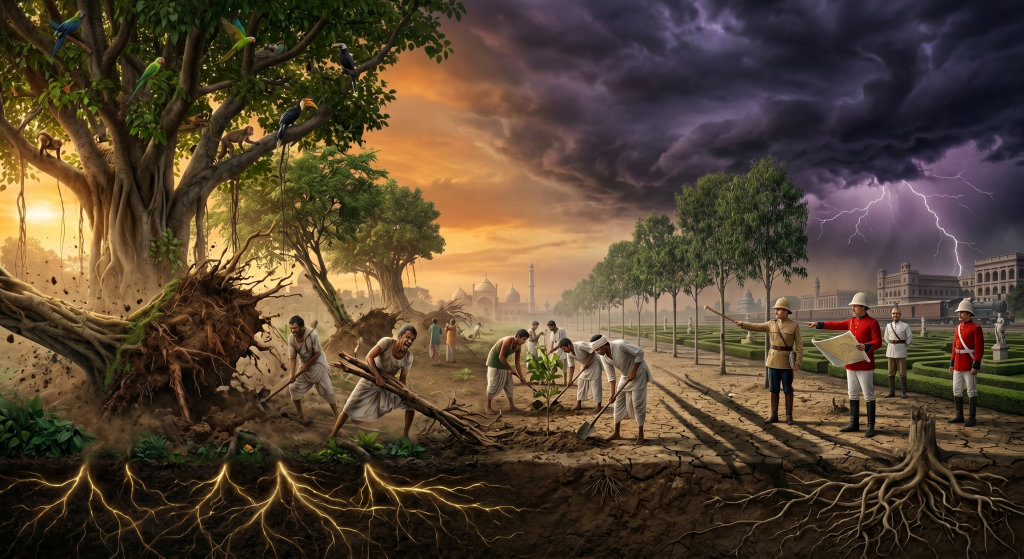
The increasing emphasis on British colonial aesthetic preferences reinforced this progressive transformation even more. British landscaping experts and planners often sought to design and recreate familiar European parks and environments in various Indian cities by planting exotic species to come up with botanical gardens and orderly avenues. Such landscapes categorically symbolized British imperial authority in the sub-continent and their cultural dominance, usually at the expense of native environmental aesthetics. Parks and public spaces were categorically transformed to reflect this colonial mindset instead of age-old local traditions.
The other thing that influenced such landscaping practices was commercial motives. Many trees like Cinchona officinalis (quinine) and Hevea brasiliensis (rubber) were introduced in the Indian soil to cater to industrial goals and colonial plantation economies. Such initiatives were driven by clear-cut British imperial economic strategies without any type of care for the ecological requirements of Indian landscapes. They also used local resources generously to benefit the goals of the colonial administration.
Main Articles: Colonial Era Trees Dominate Indian… | Less Common Colonial Trees | Indian Trees For Public Places | Why These Indian Trees Are Preferable
You may also like to read:
- Colonial Era Trees Dominate Indian Roads And Parks – 75+ Years After Independence (Main Article)
- Why These Indian Trees Are Preferable
- Indian Trees For Public Places
- Reclaiming Landscape in Indian Public Spaces from British Colonialism and Macaulayism
- The Need To Decolonize Public Landscapes In India
- How Does Continuing Colonial-Era Planting Reflect Coloniality And Ignore Ancient India’s Botanical Knowledge?
- Reviving Ancient Hindu Garden Traditions In Protected Monuments
| We encourage bharatiyas to plant Indian trees on roads, public spaces and their homes. |