
How Sivananda’s Yoga Of Synthesis Transformed The World Of Wellness
Yoga is now a multi-billion-dollar global industry, but a century ago, it was not a cultural lifestyle symbol, with branded mats and trendy activewear as it is now. And behind this revolution was one man, a revered saint from India’s Rishikesh, who quietly transformed the ancient practice. Swami Sivananda created a complete framework of yoga, called the Yoga of Synthesis (Purna Yoga), in the mid-20th century. This not only carried yoga into the modern era, but also became the blueprint for nearly every dominant yoga school today.
Shattering the Silos
For centuries, yoga was highly compartmentalised. The practitioners usually selected one of the four paths listed below, depending on their personality: Karma Yoga, the path of selfless action; Bhakti Yoga, the path of devotion; Raja Yoga, the path of meditation and mind control; and Jnana Yoga, the path of the search for knowledge and philosophy.
Sivananda viewed human beings through a holistic lens and believed them to be an intricate integration of the brain, heart, and body. He preached that building one of these facets at the expense of the others brings imbalance in the spiritual and psychological realms of life. He perfected a solution that combines all four traditional paths to create the Yoga of Synthesis. He united the head, which represented Jnana; the heart, or Bhakti; the hands, which represented Karma; and the psyche, which represented Raja, thereby developing a balanced cross-training program for the human soul. This exact holistic approach to fitness, strength, and mental clarity is the basis of all modern yoga schools.
Translating Mysticism into Modern Medicine
Prior to Sivananda, yoga was treated with esoteric secrecy, taught exclusively in Sanskrit in cryptic lineages. Sivananda applied his understanding of Western medicine to demystify these practices. He authored more than 200 books in plain, easily understood English, and correlated the spiritual advantages of yoga with the human nervous, circulatory, and endocrine system. To enable the quick-thinking modern mind to assimilate the huge volume of Vedic philosophy, he reduced everything to a brilliantly condensed six-word mantra. The six word mantra is “Serve, Love, Give, Purify, Meditate, Realize”.
This extreme streamlining removed the obstacle to entry. It turned yoga from a forbidding mountain journey into a useful toolkit for everyday use. Later, when his disciples formed their own worldwide organisations, they applied the same model of accessibility. They divided practices into courses that had a structure and were repeatable, so that everyone could understand and learn them.
Launching the Global Yoga Renaissance
A vision is nothing if not the people who spread it. Sivananda’s greatest genius was in identifying, training, and nurturing world-class visionaries and sending them to all corners of the earth to sow the Yoga of Synthesis.
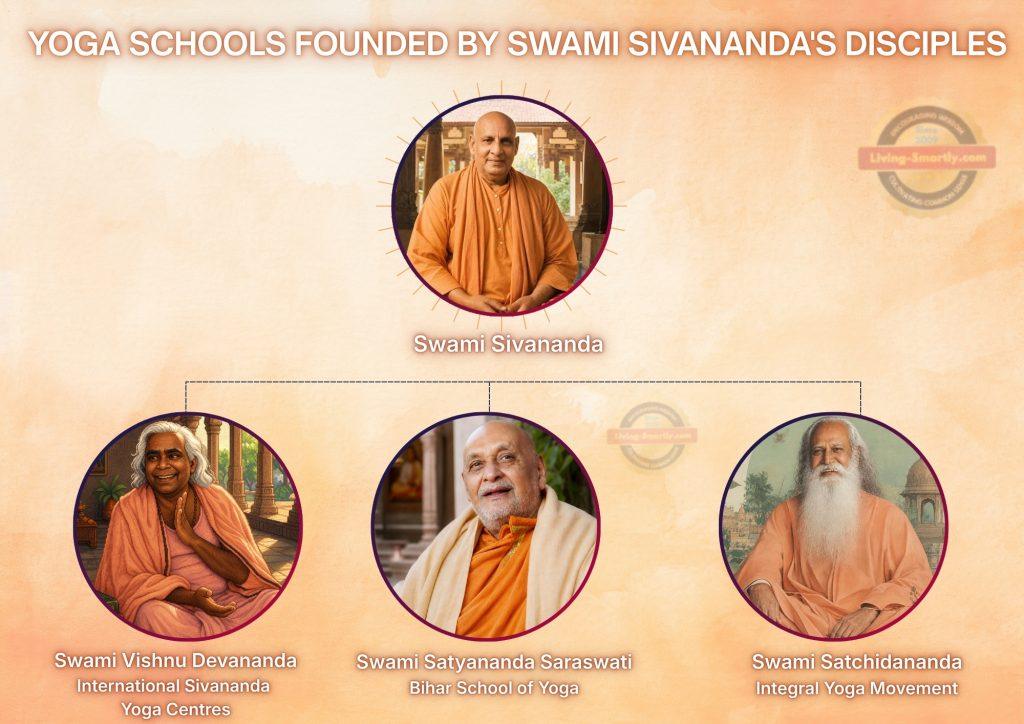
Swami Vishnu-Devananda: One of the foremost disciples of Swami Sivananda, who pioneered in spreading his Guru’s Yoga of Synthesis in the West. In 1957, he established the international Sivananda Yoga Vedanta Centers and started propagating the Yogic science to people with utmost discipline and reverence. Vishnu-Devananda reduced the Yoga of Synthesis to a set of Five Physical Points of Yoga, namely Proper Exercise, Controlled Breathing, Proper Relaxation, Balanced Diet, Positive Thinking, and Meditation. This structure of Yoga, comprising 60 to 90-minute classes, laid the foundation for modern Yoga that is taught all across the world today.
Swami Satchidananda: The founder of Integral Yoga, he had the great vision to open the Woodstock Festival in 1969 and say “peace to half a million youth. He took the Yoga of Synthesis to Western mainstream medicine, helping Dr. Dean Ornish to demonstrate that heart disease could be reversed with lifestyle changes such as yoga and meditation.
Swami Satyananda Saraswati: He is renowned all over the globe as the founder of the Bihar School of Yoga. Satyananda revolutionized the Yoga Nidra (psychic sleep), infusing a new essence of studying yoga in a scientific and therapeutic manner.
The Living Legacy
Today’s wellness market is flooded with niche and specialised offerings on yoga, ranging from mindfulness apps to physical fitness regimens. However, people still continue to look for wholesome and comprehensive solutions. That is why Yoga of Synthesis is still the foundation of today’s schools. It reminds us that there is no peace in mind without flexibility of the body, and without a peaceful mind, one cannot serve society. Swami Sivananda’s real legacy does not live on stone or marble sculpture but through the lives of millions of people who follow his revolutionary practice of yoga to step out into the world just a little more.
You may also like to read:
- Swami Sivananda: His Deeksha And Gurus – A Journey Of Spiritual Illumination
- Swami Sivananda Saraswati – Spiritual Visionary Of Vedantic Philosophy & Wisdom
- Guru, Swami, and Yogi – The Difference
- Samarth Ramdas, His Guru And Ramdasi Parampara
- Swami Samarth Ramdas – A Brief Introduction
- Swami Vivekananda
- Popular Saints of India