
5 Native Indian Avenue Trees For Neighbourhoods That Will Not Disrupt Houses Or Pavements
There is a common misconception that says, “Native Indian trees are not suited for landscaping and may disrupt civic structures”. Such a viewpoint is far from reality and needs to be debunked.
India’s native trees are ideally suited for urban environments. India is home to more than 2500 indigenous varieties of tree species. Therefore, there might be a lack of awareness of choosing the right ones.
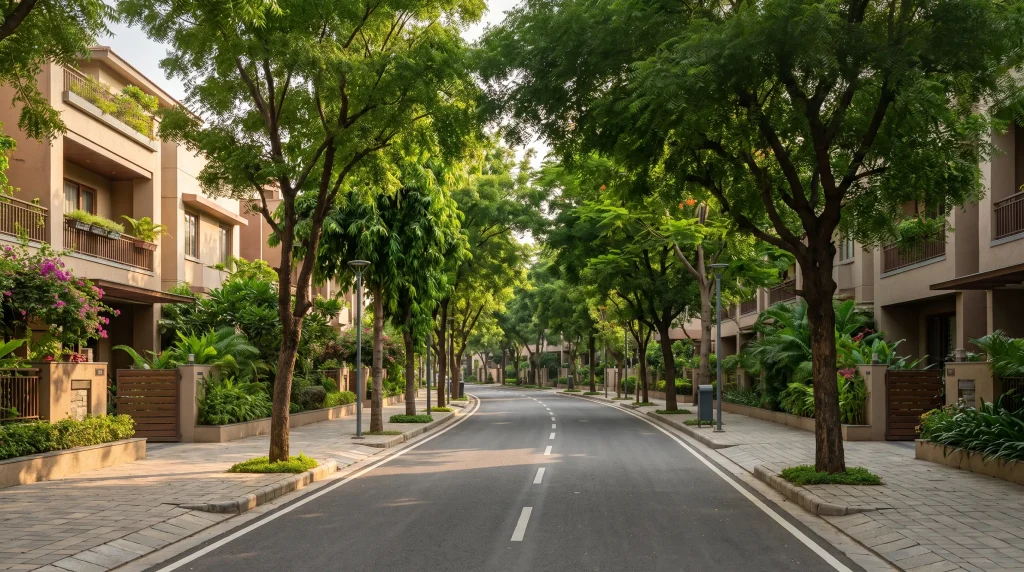
The rich biodiversity of India includes some of the most excellent varieties of native trees. By selecting species with deep anchoring taproots, you can enjoy medium-height trees that do not threaten pavements and civic structures.
What are avenue trees?
- Avenue trees form the pillar of landscape architecture.
- They play the most crucial role in transforming spaces, edging gardens, and lining roads with symmetry, beauty, and shade.
- Whether it’s decorating a serene countryside, a boulevard, or a bustling city, avenue trees bring beauty and value to the environment and architecture.
What are the advantages of avenue trees?
Planting avenue trees has several benefits.
- Community and Property value- As avenue trees mature, they increase community and property value and are a great long-term investment.
- Wildlife-friendly- Such trees provide good habitat for insects and birds.
- Beautification-Ornamental and flowering trees help boost the aesthetic appeal.
- Shade and Cooling-Trees reduce the heat effects and cool down the streets.
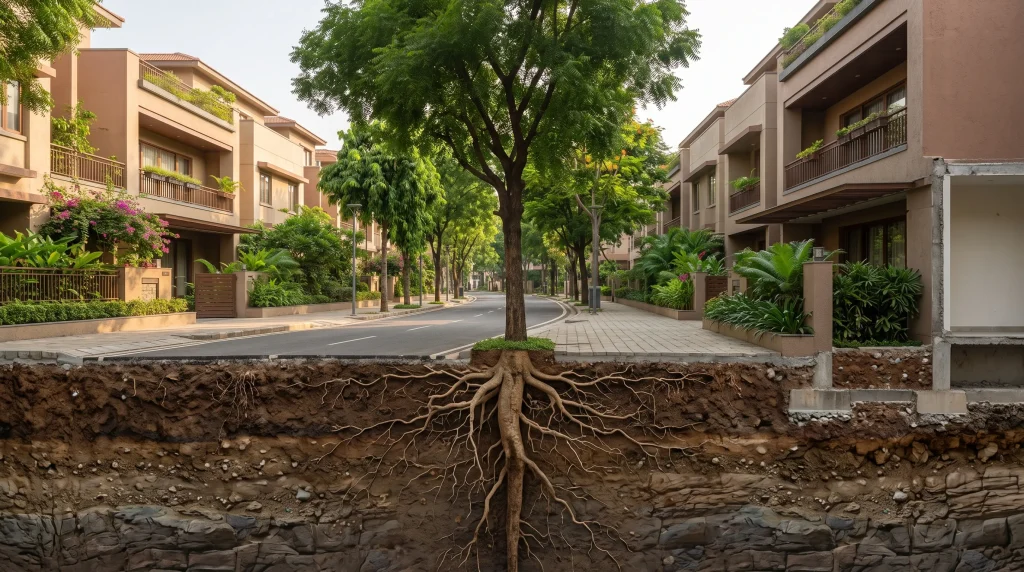
When choosing avenue trees for your neighbourhood, you must consider trees that grow to a medium height of around 8 to 15 meters with deep taproots rather than those with shallow lateral roots. Well-developed taproot systems prove to be the anchor that can help securely have the plant in the ground without causing any kind of disruptions to foundations or pavements.
Top 5 Indian native avenue trees for neighbourhoods
Some of the ultimate urban-friendly choices for planting in your own neighbourhoods in India are as follows.
Neem
One of the top choices in tree species in India. This tree is found to be most effective in carbon absorption and high-density ecosystems. Hence, neem is extensively planted across the Indian subcontinent. This native tree is highly adaptable to the climate and has excellent capabilities in carbon sequestration. Rendering to estimations, it can effectively absorb 1.45 lakh tonnes of CO2 across its lifetime.
Ashoka
A native tree, Ashoka trees can reach a height of about ten to twelve meters. It showcases a minimal lateral spread with a columnar canopy. This species features a tighter and upright canopy with deep taproots.
Amaltas
This deciduous tree, with its slender growth, can reach up to a moderate height. The clusters of bright yellow hanging flowers of Amaltas are the most distinctive feature of this tree. The primary benefit of using this tree is that it is drought-hardy and can grow up to an average height of 9 to 12 meters.
Palash
Popularly known as the “Flame of the Forest”, Palash grows to a moderate height of 10 to 12 meters. The bright orange flowers are its major highlight. This tree is amazingly tough. It also has a deep taproot and is resilient to wind and drought.
Bakul
This evergreen tree has a rounded, dense crown. This medium-height tree has a deep root system. This tree produces star-like fragrant flowers.
Final thoughts
Investing in Indian species is not only about beautification and wide selection. It is also about creating strong, sustainable, and most visually attractive spaces that will enhance the streets and the parks wherever planted.