
Will Universities Survive In The Age of AI?
Artificial intelligence, or AI, has rapidly taken over the world in recent years, influencing almost all aspects of human existence, whether academic, professional, personal, or social. In this context, it is a good time to reflect on whether universities will remain relevant in academia, where knowledge is easily and instantly accessible to everyone.
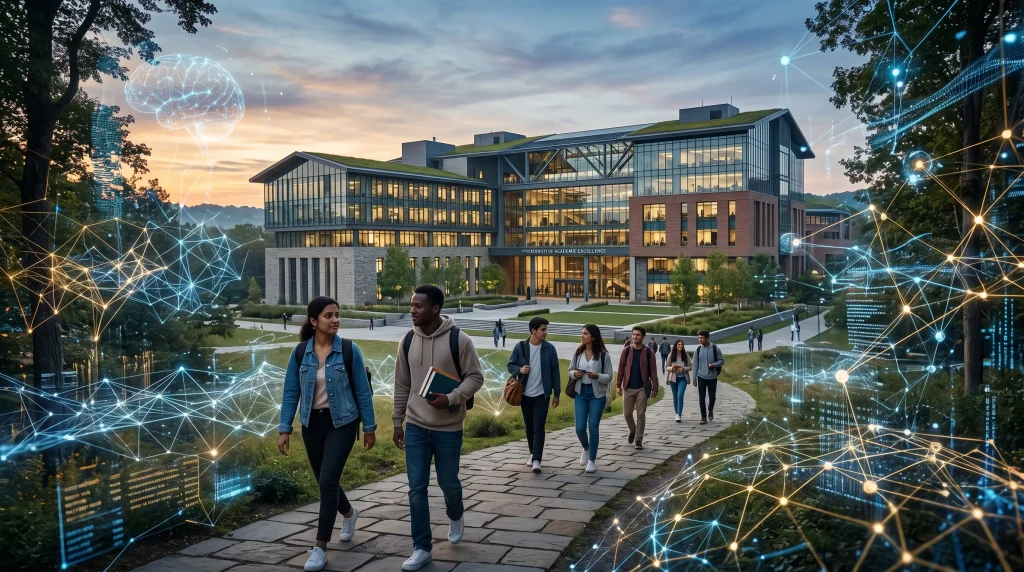
Universities have been the go-to institutions for higher learning for people across many centuries. Given that, it is too early or too simplistic to assume that universities are going to just disappear because AI has changed the way we learn things. However, one thing that everyone agrees on is that the way we learn is going to be profoundly changed by the advent of AI and its more advanced models in the days to come.
To understand the nature of this change, we need to first understand what universities can offer us, apart from mere information. One of the most crucial reasons why universities are going to stay despite the progressive changes brought in by AI is that they can offer career credentials that one cannot get directly with AI learning. A degree attained after successfully completing a course from a university is not just about accumulating knowledge and information, but a sign that one has mastered a certain branch of learning. It provides information to a prospective employer that the student has been through a structured and verified learning process. Although AI can offer lessons on any given subject, it cannot provide an extensively trusted certification on a large scale without any institutional backing. Hence, universities offer validation of competence on a subject so that a person becomes capable of finding work in that field of study.
The other important thing about universities is rooted in the social and human dimensions of university life. While studying at a university, apprentices get a hands-on experience in learning that is not just restricted to lectures and textbooks. They also get exposed to networking, collaboration, diverse perspectives, and develop a spirit of independence. This is something that AI can never replicate fully.

While simulated AI conversations can impersonate normal human interactions, they cannot just replace the depth and complexity of real human interactions and relationships that develop through shared experiences. Additionally, universities also function as extensive research hubs, where they arrange for funding, promote interdisciplinary collaboration, and present students with an elaborate infrastructure for innovation. Even though AI can enhance and accelerate research, universities are going to play an important role in coordinating and legitimizing it.
It is, however, significant to note that the traditional structure of universities is presently being disturbed. AI tutors are also able to offer clear clarifications to countless complex concepts, adapt easily to different kinds of learning styles, and are available 24/7. For this reason, traditional lectures by lecturers are trailing their earlier importance. Hence, universities will now need to change toward project-based learning, mentorship, and intricate real-world problem-solving. All of these are some of the areas where AI might not help directly. This is where human guidance still has a critical role to play.