
Sanatana Dharma And The Circular Economy: Ancient Wisdom For A Warming Planet
Take-Make-Dispose to Harmony with Nature
As the effects of global warming continue to take their toll, communities are facing the impact of extreme weather events, and natural resources are diminishing; sustainable alternatives to the linear economy are needed. The traditional use of resources involves making products, using them up, and producing waste. A more sustainable solution is the circular economy: reduce, reuse, and recycle waste and pollution, keep materials in the economy for longer, and regenerate natural systems.
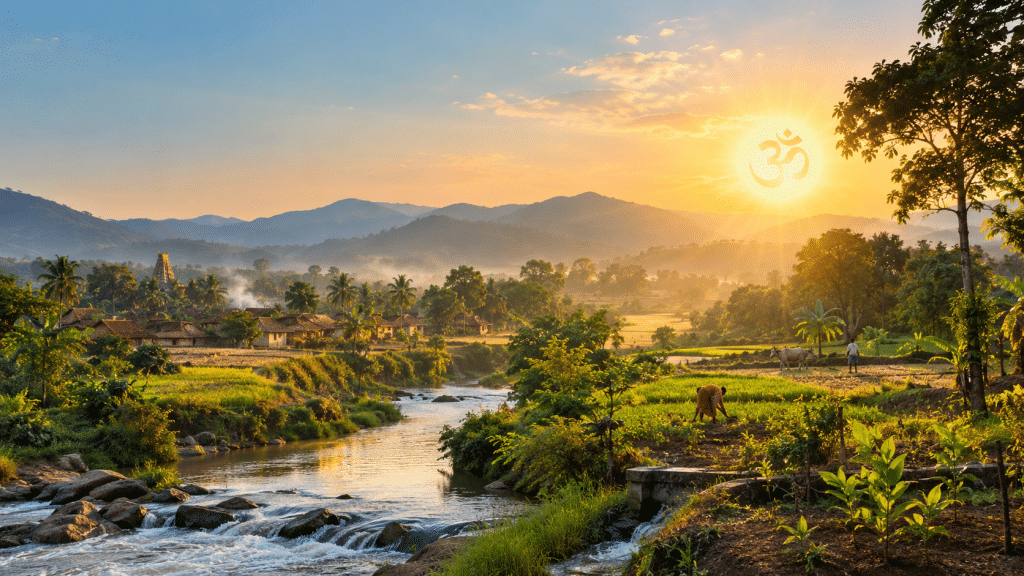
True enough, there are ethical principles in Sanatana Dharma which are closely linked with this vision of the circle. There is no modern model of a circular economy that needs to be developed in India, but the ancient Indian mindset of interconnectedness, restrain and reciprocity is certainly relevant and very important to sustainability.
- Ṛta: Living Within Nature’s Order
The Rigveda’s notion of Ṛta is a representation of “the order of the cosmos that sustains life. Its environmental relevance is that it is a knowledge of the balance of life which is necessary for human life. A linear economy has the tendency to regard nature as a limitless resource and the environment as a limitless dumping ground. This is challenged by the worldview of Ṛta – if the ecological balance is disturbed by the humans, then the society will suffer sometime. Protecting the natural systems which generate economic prosperity is an essential foundation of any real economic progress. - Aparigraha: Overcoming the tendency to indulge in consumption
Aparigraha means non-possessiveness, which teaches an individual not to accumulate. In line with the Indian philosophical school of thought as presented i n the Yoga Sutra of Patanjali, it negates the notion that anything more results in more joy. It stresses the practice of adopting a circular economy, which basically espouses repairing instead of replacing, re-use rather than dismantling, sharing under-utilised resources, and also making durable products. Aparigraha does not say anything against wealth; it simply is against excess. - The Principle of Reciprocity
Vedic philosophy holds Yajna in high regard and considers it synonymous with acts of gifting, sacrifice, or use of mutual agency to ensure life. This provides an ethical parallel to circularity. If there are resources, human beings have to be responsible to those systems that are providing them. This can be seen in modern composting of organic waste, recycling of materials, the conservation of water, and restoration of forests. Renewal should be in the hands of the taker from nature. - Pancha Mahabhuta: Conservation of the five building blocks of nature
Pancha Mahabhuta (earth, water, fire or energy, air and space) is a philosophical understanding to look at the interconnection of human beings and nature. Currently, it is manifested in soil protection, water conservation, the use of cleaner energy, the reduction of air pollution, and the efficient use of resources. The public dedication to conservation may also be enhanced by worship of water, forests, and living beings. The scientific knowledge and sound environmental policies should be relevant to and serve ancient wisdom, not replace it.
Conclusion: Prosperity without Ecological Destruction
The contribution of Sanatana Dharma is not that it predicted all the environmental problems today but that it has a timeless and moral solution to the environmental problems. From businesses to communities and governments, all can adopt practices such as creating sustainable products, cutting down waste, encouraging responsible consumption, and implementing the use of renewable energy.
The linear economy is asking the question: How much can be taken & used? So, the circular economy question is: How clever can we be about re-using and regenerating? What is our responsibility towards nature that nourishes us?
Sustainability won’t be realised by the mere use of new technologies; it’s about changing the way we perceive prosperity- from unlimited consumption to ecological balance, living responsibly, and a prosperous planet for generations to come.