
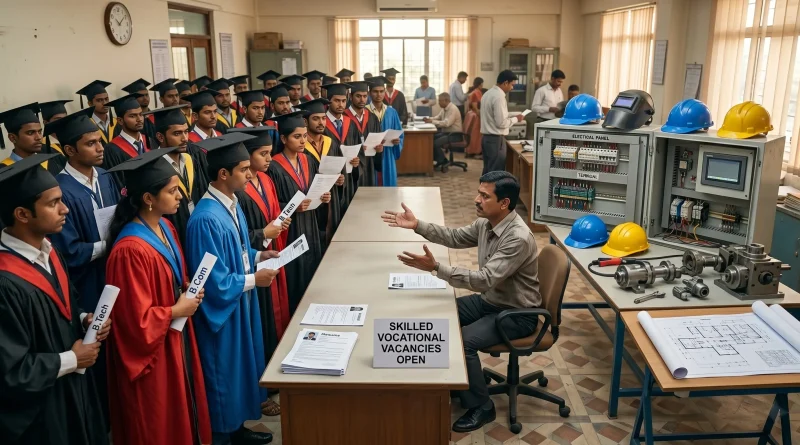
The Indian Education System’s Heavy Bias Toward Academic Degrees Is Unlike That Of Most Developed Countries
There is a heavy bias when it comes to the Indian education system. India’s education system places too much emphasis on the classic academic degrees and too little on the level of vocational education, thereby limiting its ability to use its large labour market effectively. This stands in sharp contrast to the highly developed economies like Germany, the United States, Japan, and France. These countries have strong technical and vocational systems that contribute directly to their industrial growth and development.
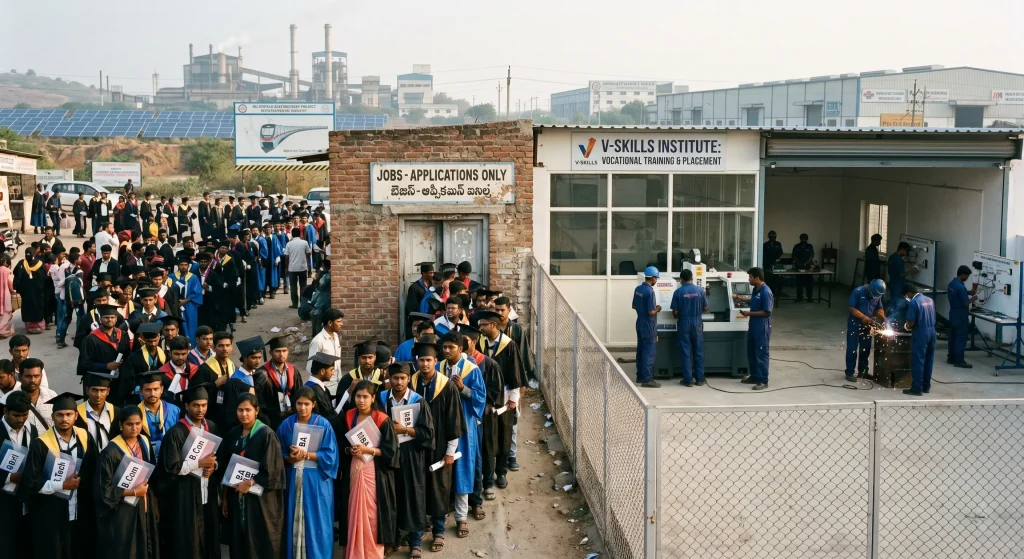
Traditionally, there has always been a preference for degrees like B.Tech, M.Tech, B.Com, and BA. This mentality is deeply ingrained as one of the key markers of social mobility and career success. While vocational streams such as polytechnics as it is are often viewed as the last resort or second alternatives.
The facts and figures tell a clear and vivid story. Around 75% to 85% of post-secondary students in India go to university and seek higher education programs. While the percentage that enters the technical and vocational fields is only 15% to 25%. By contrast, most Western countries like Germany maintain a near-even balance between vocational training and university education. In our neighbouring country, like China, about 40% to 50% of students enter vocational education during their post-secondary years. Even in most advanced nations such as Japan and the United States, there is a better balance between vocational and technical education, which benefits both students and the economy as a whole.
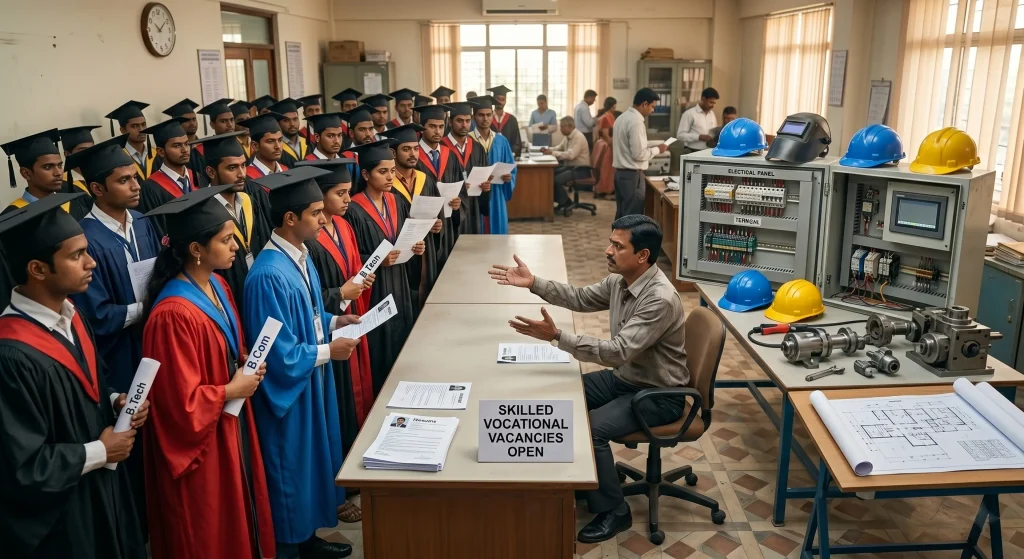
There are 40 to 45 million students enrolled in higher education at the present moment, and most of them pursue degrees in science, commerce, arts, engineering, management, and related academic disciplines. However, the expanse of vocational institutions like the Industrial Training Institutes (ITIs), apprenticeships, polytechnics, and skill-development programs still remains relatively small. For this reason, there is a huge dearth of formally trained skilled workers and technicians who can contribute to the growth of the country’s industrial sectors.
It is surprising to note that only about 4% to 5% of the workforce in India receives formal vocational training, which can be an advantage for the industrial sectors. On the other hand, countries like South Korea, Germany, and the United States boast of around 90%, 70%, and 50% participation in vocational training, respectively. Such an imbalance has led to a major disparity in our country’s labour market.
Millions of students graduate every year with academic degrees in India. However, employers around the world still find that there is a consistent shortage of professionals and skilled experts like electricians, welders, machinists, maintenance technicians, healthcare technicians, logistics specialists, construction supervisors, and machine operators. Hence, there is a huge unemployment problem in the country. What seems like a shortage of jobs is nothing but a shortage of people with the right skill sets required by industries looking to hire eligible people. This is the major reason why it is so very important to emphasize the significance of vocational training in India in the coming years. The gap between the labour market and the education sector can be minimized with stronger industry-university partnerships. Moreover, there must be more mandatory internships to bridge any gaps and to encourage more and more students to consider skill development and vocational training.
You may also like to read:
- 64 Kalas, Chausat Or Chathushasti Kala
- India’s Workforce Has The Lowest Formal Vocational Training Among Major Economies
- Excessive focus on university education is making Indian youth unemployed and unemployable
- Salient Features Of Germany’s Dual Vocational Training System
- Fostering Entrepreneurship: Empowering Youth Through Vocational Skills And The Wisdom Of 64 Kala
- Career Success – Academic Learning, Practical Knowledge, And Vocational Skills
- Bridging The Skills Gap: Addressing Industry Demands With Targeted Training Programs
- Empowering Employability: How Practical Skills Make Youth Job-Ready And Reduce Unemployment Rates
- Vocational Education Improves Employability
- What Kind of Students Benefit From Vocational Education?