
Garden Traditions Of Hindu Temples
There are many historic temples across India. Most temples were not simply architectural marvels; they were much more. They served as living ecosystems. Nowadays, as conservation efforts are being planned, greater emphasis has been placed on preserving stone structures. This is where it is also found that the gardens often remain overlooked.
The ancient and sacred garden traditions of India played a crucial role in defining community life, while maintaining a sustainable ecological system that preserved temple rites and rituals. It is now significant for us to reintegrate these age-old practices in India’s protected monuments as a way of reinstating and preserving both cultural authenticity and environmental balance.
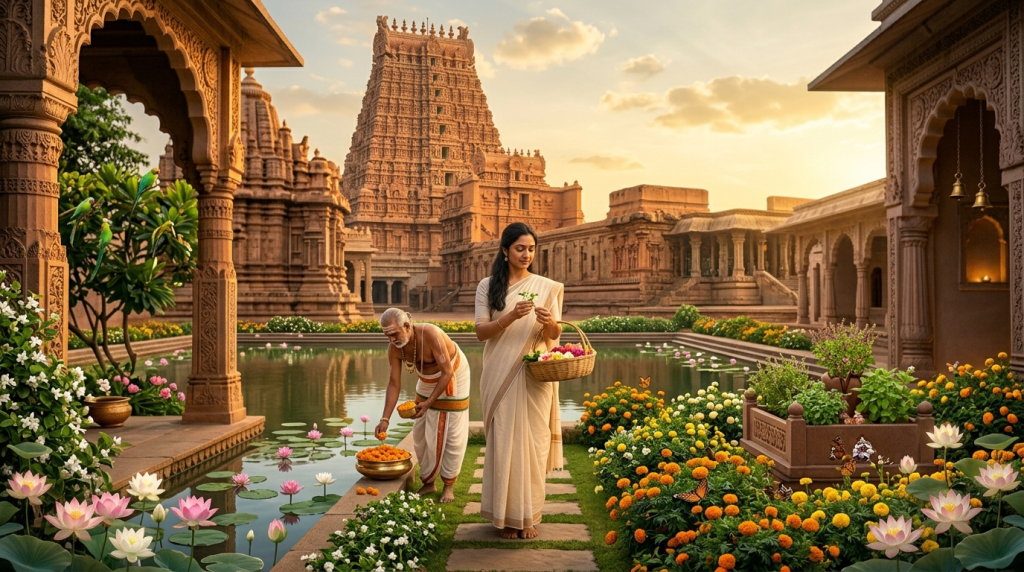
Located in Madurai, the Meenakshi Amman Temple is one of the best examples of how these temple landscapes often functioned historically. The ecosystem of this temple included a divine garden, called the “Nandavanam”. It was a carefully curated and maintained garden. The entire space was used for growing flowers and important sacred plants. All of which played a central role in daily worship.
Jasmine, marigold, lotus, champaka, and Tulsi are some of the chosen varieties of plants and flowers grown in the temple gardens. They were all indispensable for making garlands, ritualistic use during festivals, and even in the use of intimate and elaborate decoration of the puja shrine. Instead of just being an ornamental space, the garden served as a functional component of the temple, thus preserving the tradition of essential temple rituals.
Another important aspect of the Indian temples was the water systems that were included with them. For instance, the s Golden Lotus Tank of the Meenakshi Amman Temple, also recognized as the Potramarai Kulam, effectively served as a symbol of the connection between plant life and water. Tanks like these were not just ritual spaces, but they helped in irrigation, allowed for the maintenance of moderate temperatures at all times, and improved biodiversity within the dense urban environments. Structures like Vandiyur Mariamman Teppakulam that extended beyond the immediate temple walls helped to improve this ecological system, seamlessly combining ceremonial landscapes and smart water management.
Another equally profound but different practice can be observed at the Srivilliputhur Andal Temple, wherein the garden remained deeply inseparable from and connected to mythology and devotion. As per oral traditions, poet-saint Andal was once discovered under a Tulsi tree in the garden by Periyalvar. Such an origin story gave the temple garden its uniquely sacred narrative, which elevated it from being a mere physical space. The temple still continues its tradition of offering flower garlands that were first worn by poet-saint Andal to God Vishnu. This specific ritual, followed by the devotees, is profoundly rooted in a long-held legendary story of divine acceptance. Such a practice transforms the meaning of the garden from a space.
The design of temple gardens in the past holds a lot of significance. It not only shows a symbol of connection and intimacy between the devotee and the divine. It holds importance in terms of gathering raw materials needed for day-to-day worship. This clearly elucidates how ceremonial rites and rituals, storytelling, and the cultivation of diverse plants are extremely entwined.
Such illustrations validate a broader principle where ancient Hindu temple gardens served as sacred and holistic spaces. They created unified landscapes where flower cultivation, sacred trees, medicinal plants utilized in Ayurveda, and water bodies all became one. Unlike the British gardens that focused on shape, symmetry, and visual appeal, these ancient garden spaces supported religious rituals, community health, and preserving perfect environmental harmony.
You may also like to read:
- Reclaiming Landscape in Indian Public Spaces from British Colonialism and Macaulayism
- Reviving Ancient Hindu Garden Traditions In Protected Monuments
- Criticizing British Colonial Rule For Introducing Foreign Plants In Public Spaces
- The Need To Decolonize Public Landscapes In India
- How Does Continuing Colonial-Era Planting Reflect Coloniality And Ignore Ancient India’s Botanical Knowledge?
- Colonial Trees vs Native Indian Substitutes for Roads and Parks
- Medicinal Plants In Public Landscapes In Ancient India