
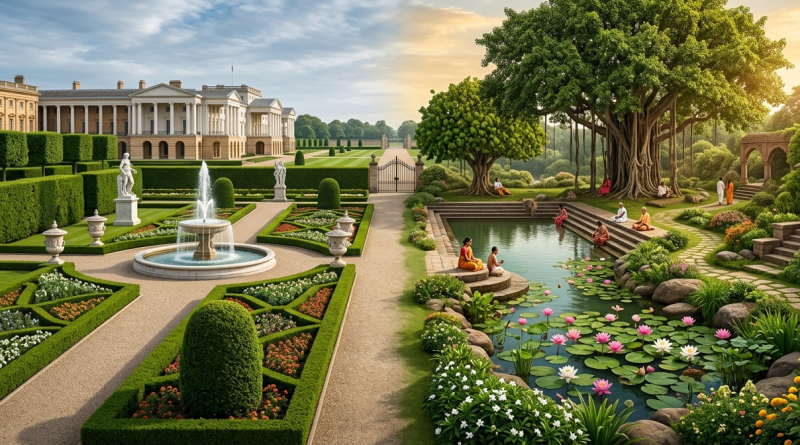
Landscaping – British Colonial Imperialism vs Indian Tradition
Landscaping is not simply a way to arrange plants and greenery in a specific way. Along with its social structures and the relationship it has with nature, landscaping also reflects the deeper cultural values of a country. It is the art and science of creating gardens, landscapes, and open spaces. While enhancing its visual appeal, it also helps preserve the ecological balance of the location.
When one tries to comprehend the distinction between India’s ancient landscaping traditions and the colonial landscaping practices of the British, they are often challenged to understand the differences. These are two essentially different worldviews or outlooks.
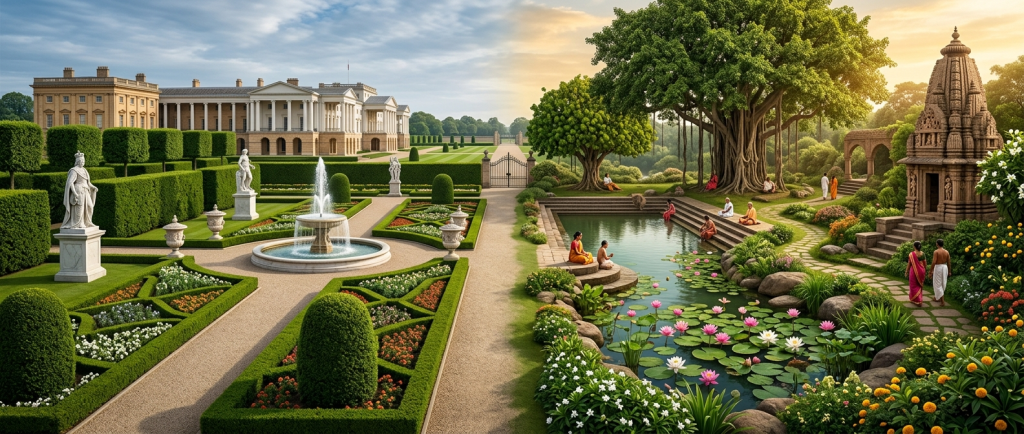
To provide a more vivid understanding, it is helpful to first consider the distinct worldviews underlying each approach. For instance, British colonial landscaping techniques underlined aesthetics, control, and the external projection of the Crown’s imperial power. However, Indian landscaping, since its earliest times, essentially focused on spirituality, harmony, and ecological balance.
The seasonal cycles, climatic conditions, and natural terrain had a vast impact on the landscaping designs. Likewise, water bodies, like stepwells, temple tanks, and ponds, effectively served symbolic and functional purposes, representing life and holistic purification. Such landscaping elements were not just isolated decorative elements. They were very much integral to community rituals, daily life, and social interaction among people.
Nature was always seen as something consecrated that should be preserved and connected with all facets of human existence.
In ancient India, landscaping practices were essentially influenced by factors that were ecological and spiritual. Both these concepts gained prominence in the traditional methods. Banyan, neem, and peepal were considered sacred and thus were not merely cherished for their shade. However, there were deeper aspects that related to their devout significance. The significant goal of such performances was to create a harmonious bond between nature and mankind.
Another important part of ancient Indian landscaping techniques was its climate responsiveness. Using native plants was a way to preserve resilience and sustainability. These plants were perfectly adapted to India’s natural conditions. Several public spaces were designed organically. Strategically designed and placed water bodies, courtyards, and shaded pathways were the distinct highlights of the colonial designs. Moreover, these helped to keep the settlements naturally cool. Hence, their designs efficiently blend with their natural surroundings. The evidence of the rich designs can be witnessed everywhere, whether it’s in their palatial palace gardens, temple complexes, and sacred groves.
Enthused by English estates and Victorian aesthetics, colonial landscapes often featured wide lawns, symmetrical layouts, and straight avenues. Turning to the colonial era, such projects often overlooked the natural terrain and reshaped it to fit specific geometric patterns. The primary goal of British rulers was to establish European sensibilities and impose their imperial authority on the order of the landscape. If we now contrast the landscaping practices during the British colonial rule in India, we can find an entirely different set of ideas, principles, and priorities.
The techniques of colonial landscaping also had another important role. They served various kinds of administrative and political purposes. For instance, planned spaces like civil lines, cantonments, and government complexes were created to separate European communities from the local populations. Expansive lawns and grand avenues around important official buildings symbolized control, power, and dominance. In this context, nature was something to be categorically organized and displayed instead of being respected and integrated.
The British also broadly delved into botanical experimentation. Sprawling botanical gardens also served roles like economic exploitation and scientific classification. Thus, they were not just spaces for aesthetic enjoyment. Plants like tea and rubber were introduced for their commercial benefits, and water management methods like controlled irrigation systems and ornamental lakes mainly prioritised aesthetic decor.
You may also like to read:
- Reclaiming Landscape in Indian Public Spaces from British Colonialism and Macaulayism
- Reviving Ancient Hindu Garden Traditions In Protected Monuments
- Criticizing British Colonial Rule For Introducing Foreign Plants In Public Spaces
- The Need To Decolonize Public Landscapes In India
- How Does Continuing Colonial-Era Planting Reflect Coloniality And Ignore Ancient India’s Botanical Knowledge?
- Colonial Trees vs Native Indian Substitutes for Roads and Parks
- Medicinal Plants In Public Landscapes In Ancient India
- Landscaping Goals – British Colonial Imperialism Versus Indian Tradition