
Europe Tried To Control Nature, Bharat Learned To Live Within It
Two Civilizations, Two Visions of Nature
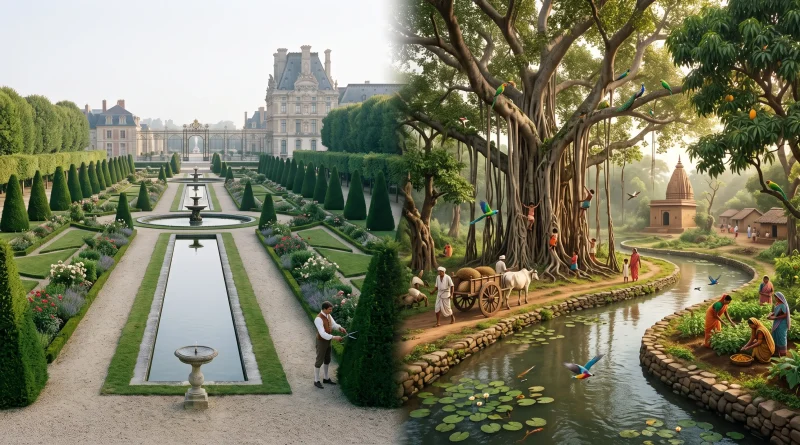
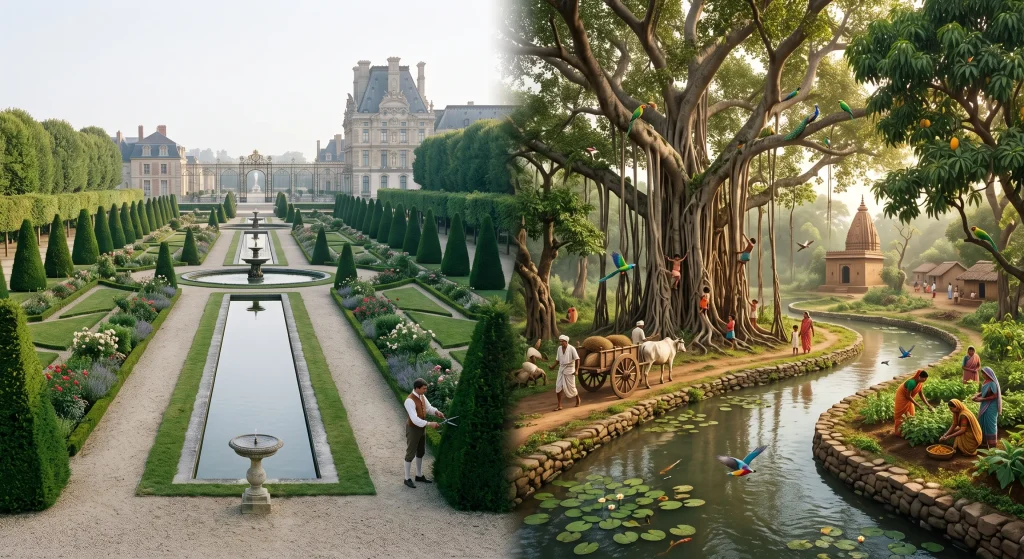
The geography of civilization gives a glimpse into its perception of nature. Gardens are never merely a collection of trees, flowers, and pathways, but are a living statement of culture, philosophy, and values. Over the last thousand years or more, Europe and Bharat have developed two distinctly different philosophies of nature making. One wanted to learn it from geometry and control. The other wanted to grow as it grew. However, this contrast is once again gaining fresh significance given the challenges of climate change, biodiversity loss, and water scarcity that our future faces today.
The European Ideal: Nature Under Human Command
When applied to the natural world, many Europeans believed that reason could improve from the Renaissance to the Enlightenment. The most succulent expression of this philosophy was in the gardens of the aristocrats, which were symmetrical, exact, and ordered—the very characteristics of civilization itself. This worldview was illustrated in the splendid gardens at Versailles. Straight canals, trimmed hedges, geometric flower beds, and straight avenues were evidence of man’s mastery of nature. Beauty was created not through the natural evolution of ecosystems, but through their manipulation in line with human design. They symbolized strength, authority, and the victory of civilization over nature. Untamed forests meant chaos; carefully engineered landscapes meant progress.
Bharat’s Ecological Intelligence
The ecological conditions in which Bharat evolved were completely different. The monsoon, tropical biodiversity, seasonal rivers, and various climatic zones required adaptation rather than domination. As a result, Indian gardening cultures involved sharing existence with natural processes and systems rather than resisting or dominating them. Ancient Indian literature on Ayurveda demonstrates extensive knowledge of soil fertility, irrigation, grafting, medicinal plants, and seasonal cultivation. But what was truly innovative about India was its approach to ecology rather than its science.
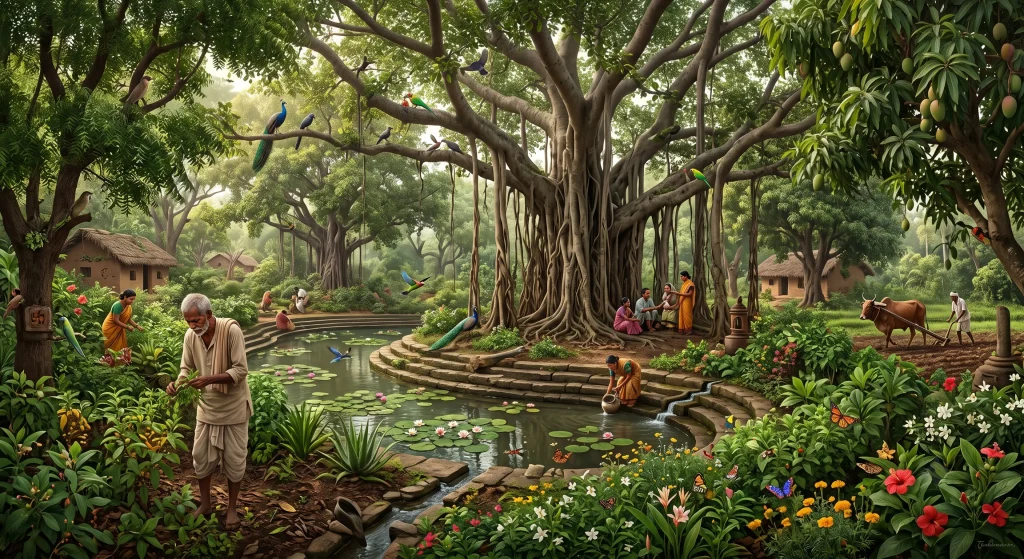
There was no dichotomy between nature and human civilization. It was known as a web of life in which humans were not the masters but also were its members. For instance, Neem helped purify the environment and provided medicine. Mango provided food and shade. For generations, sacred groves were not protected by government regulations but by cultural reverence and respect, which safeguarded entire ecosystems. Efficacious, productive gardens integrated fruit trees, medicinal plants, water collection, and biodiversity to create living landscapes.
When Colonialism Imported a Different Landscape
British colonialism not only changed India’s political institutions but also its environmental aesthetics. The large colonial bungalows, with their sweeping green lawns, came to represent a new sense of prestige. Landscapes were inspired by English country estates, with a focus on ornamental rather than ecological value. The colonial era saw the creation of botanical gardens, which added exotic ornamental plants and promoted European conceptions of landscaping. Colonial lawn culture frequently imported European aesthetics without considering the ecological appropriateness of the importation.
How Bharat’s Model Matters Today
The principles of sustainability, which were being used in India for centuries, are now receiving revalidation in modern days. Today, public understanding and scientific consensus are unanimous in their view that healthy ecosystems cannot be easily created with controls that are reflected in regenerative gardening, biodiversity restoration, native planting, agroforestry, and climate-resilient landscapes. While the contribution of lawns to biodiversity is comparatively small, in contrast, native gardens offer an array of benefits from cooling cities to storing carbon, replenishing groundwater, and building ecological resilience.

The Garden as a Civilizational Choice
For centuries, European’s believed that they had conquered nature, and it was the most important achievement in progress. Bharat, through its ecology, has mostly shown another way of doing things, one that is observant, adaptive, reciprocal, and co-existential. The history of any civilization is not without complexities and contradictions; however, the Indian approach is unique in its understanding that human beings are not separate from nature but are an integral part of it.
Further Reading:
Why Indian Trees Prefereable? | Indian Trees For Public Places | Less Common Colonial Trees
You may also like to read:
- How Colonialism Changed Gardening In India: From Native Landscapes To British Lawn Culture
- Useful Ayurvedic Plants And Trees Must For Homes and Neighbourhoods
- Reclaiming Landscape in Indian Public Spaces from British Colonialism and Macaulayism
- Why These Indian Trees Are Preferable
- Indian Trees For Public Places
- Criticizing British Colonial Rule For Introducing Foreign Plants In Public Spaces
- The Need To Decolonize Public Landscapes In India
- How Does Continuing Colonial-Era Planting Reflect Coloniality And Ignore Ancient India’s Botanical Knowledge?
- Reviving Ancient Hindu Garden Traditions In Protected Monuments